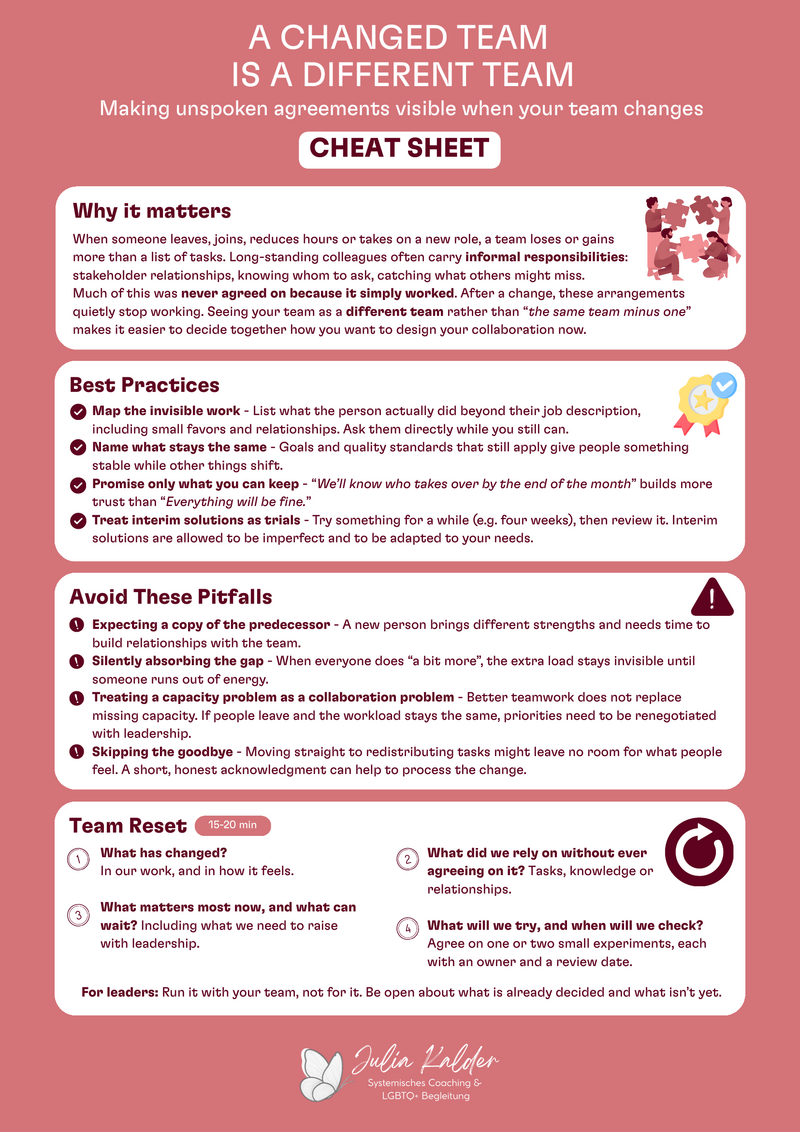
When someone leaves, joins, reduces their hours, or takes on a new role, a team loses or gains more than a list of tasks. Long-standing colleagues often carry informal responsibilities: stakeholder relationships, knowing whom to ask, catching what others might miss. Much of this was never agreed on because it simply worked — and after a change, these arrangements quietly stop working. Seeing your team as a different team rather than “the same team minus one” makes it easier to decide together how you want to design your collaboration now.
A few practices help. Map the invisible work: list what the person actually did beyond their job description, including small favors and relationships — and ask them directly while you still can. Name what stays the same: goals and quality standards that still apply give people something stable while other things shift. Promise only what you can keep: “We’ll know who takes over by the end of the month” builds more trust than “Everything will be fine.” And treat interim solutions as trials: try something for a while, for example four weeks, then review it. Interim solutions are allowed to be imperfect and to be adapted.
Watch out for the common pitfalls: expecting a copy of the predecessor instead of giving a new person time to bring different strengths and build relationships; silently absorbing the gap until someone runs out of energy; treating a capacity problem as a collaboration problem — better teamwork does not replace missing capacity, so priorities need to be renegotiated with leadership; and skipping the goodbye, which leaves no room for what people feel. A 15–20 minute Team Reset gives the change a structure: What has changed — in our work and in how it feels? What did we rely on without ever agreeing on it? What matters most now, what can wait, and what do we need to raise with leadership? What will we try, and when will we check? For leaders: run it with your team, not for it, and be open about what is already decided and what isn’t yet.