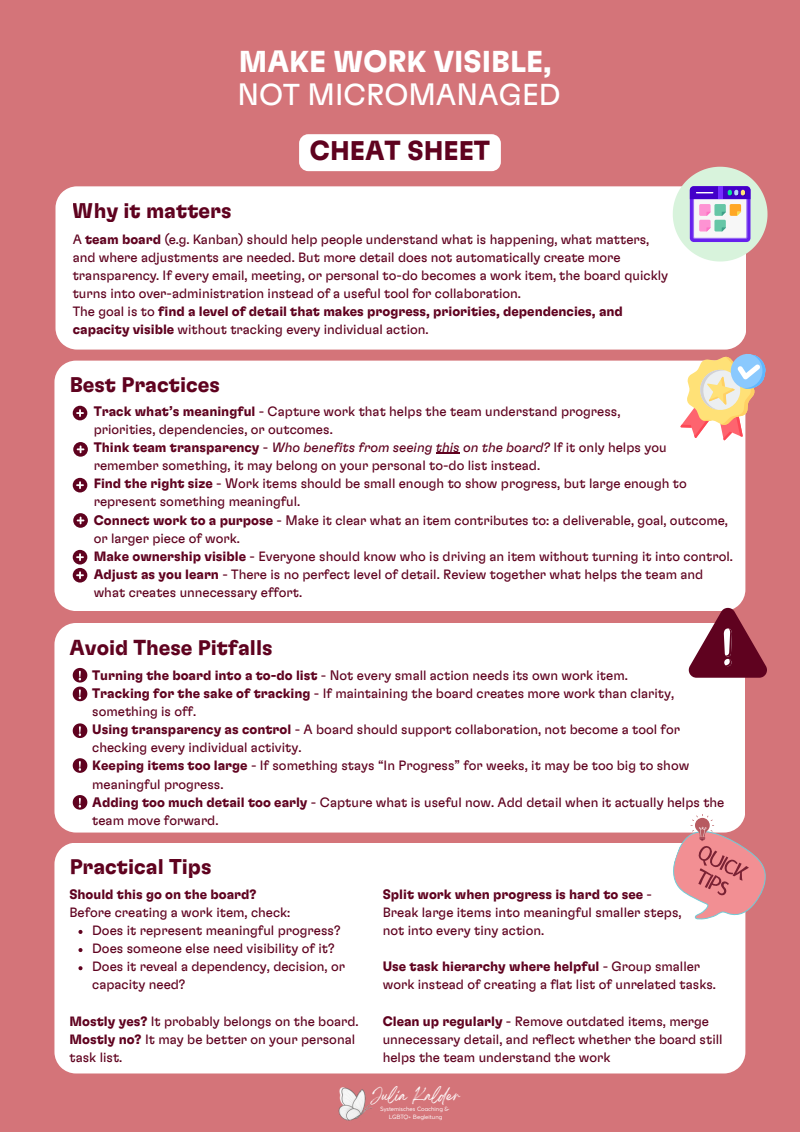
A team board — Kanban or otherwise — exists to help people understand what is happening, what matters, and where adjustments are needed. But more detail does not automatically create more transparency. When every email, meeting, and personal to-do becomes its own work item, the board tips over into over-administration and stops being a useful tool for collaboration. The goal is a level of detail that makes progress, priorities, dependencies, and capacity visible without tracking every individual action.
A simple test helps before creating an item: who benefits from seeing this on the board? If it only helps you remember something, it probably belongs on your personal task list. Beyond that, size matters — items should be small enough to show progress, but large enough to represent something meaningful. Connect each one to a purpose (a deliverable, a goal, an outcome) and make ownership visible without turning it into control. There is no perfect level of detail, so review together what actually helps the team and what just creates effort.
The typical traps are easy to recognise: turning the board into a to-do list, tracking for the sake of tracking, using transparency as a control mechanism, keeping items so large that they sit in “In Progress” for weeks, and adding detail long before it helps anyone. Practical counter-moves: split work when progress is hard to see, but into meaningful steps rather than tiny actions; use task hierarchy to group smaller work instead of building a flat list of unrelated tasks; and clean up regularly — remove outdated items, merge unnecessary detail, and check whether the board still helps the team understand the work.